Philipse Manor Hall State Historic Site offers lectures on a variety of topics to adult groups onsite, offsite, and virtually. Lectures are presented by our professional historians. Fee is $50/program. To book, email philipsemanorhall@parks.ny.gov or call 914-065-4027.
The Philipse family were the wealthiest people in New York for a century, but do you know the whole story? This illustrated talk explains not only the Philipse family, but also the everyday lives of Indigenous, African-descended, and European people living and working in Colonial Westchester, from New Netherland to the American Revolution. Talk includes an overview of the newly renovated Philipse Manor Hall State Historic Site exhibits and programs.
The New York City we know today is a world completely apart from the one early Dutch colonists created in the 1620s. But the street layout of Lower Manhattan remains relatively unchanged from that time. Join Philipse Manor Hall State Historic Site Manager Michael Lord on a journey back to the New York of the Philipses’ era – from the 1640s to the American Revolution. We’ll stop at Philipse-related properties around the city, learn about the locations of major events like the Insurrection of 1712, the Conspiracy of 1741 and the Great Fire of 1776, and get a feel for the street-level view of this historic city through time.
The American Revolution officially ended on September 3, 1783, with the signing of the Treaty of Paris. It was a stunning loss for the British Empire, and thousands of British troops and even more Loyalists were still in the American colonies. Although evacuations occurred in all the major Atlantic ports, New York City was one of the largest, and the last to evacuate. The British under General Sir Guy Carleton had begun evacuating New York in August of 1783, and all British citizens were to be gone by noon on November 25, 1783. Like many Loyalists, the Philipse family went with them, abandoning the Philipse Manor for the safety of England. November 25th became known as “Evacuation Day,” and became an early American holiday as the Patriots celebrated their victory and the freeing of New York City from British occupation. Learn what happened to the Philipses, Philipse Manor, their tenants, and the people they enslaved following the American Revolution.
Colonial New York City was the location for two large scale insurrections and conspiracies planned and enacted by the city’s sizable enslaved community. Not surprisingly, enslaved individuals of the Philipse family played a part in both plots. Join historian and Philipse Manor Hall’s Site Director, Michael A. Lord, as he discusses these plots and other methods of resistance carried out by the enslaved community in 18th century New York.
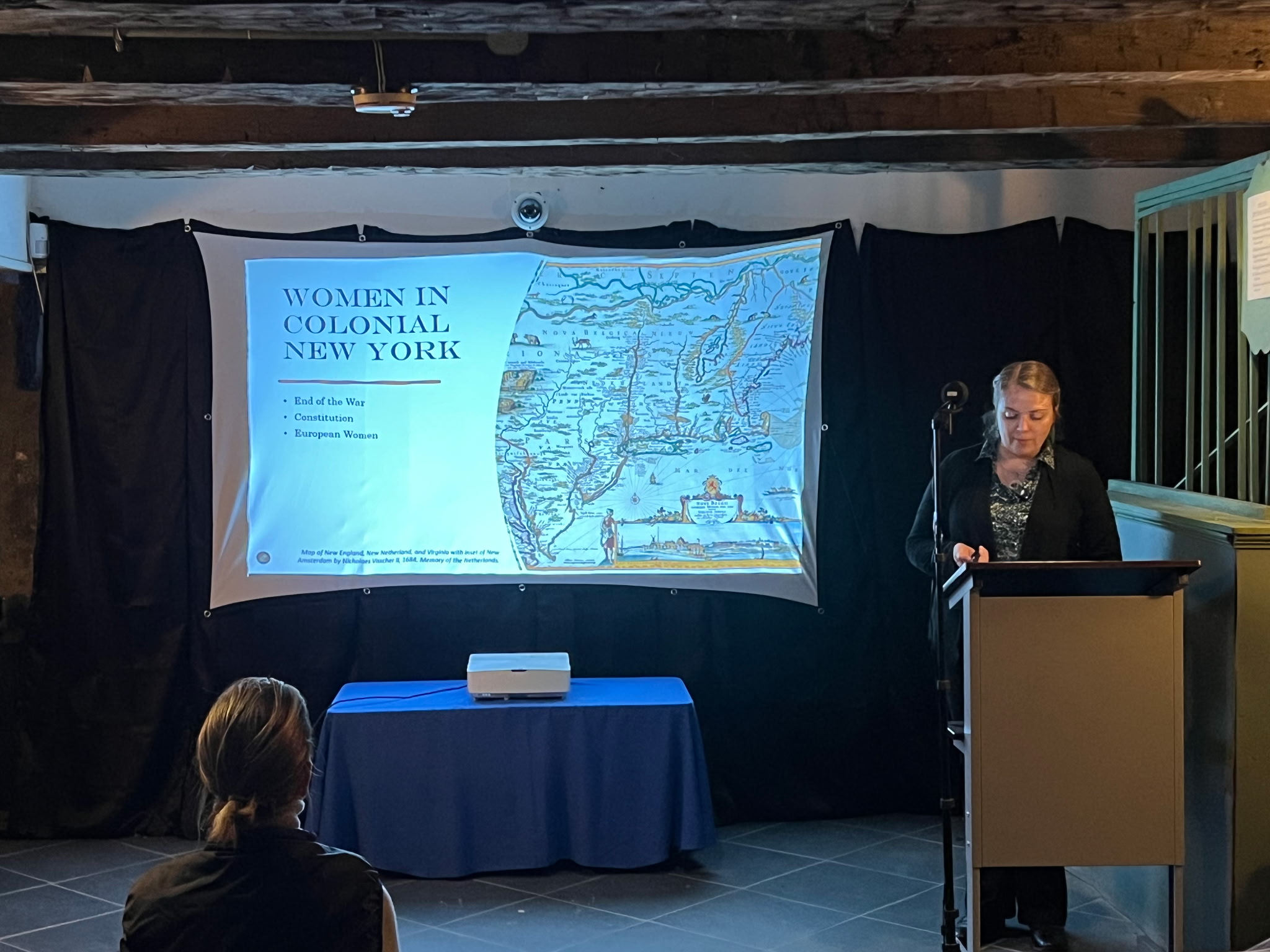
New York was one of the most diverse of the thirteen colonies, thanks to its Dutch colonial roots. Racial religious and racial diversity meant that colliding cultures had different ideas of how to treat women. Learn about women’s rights (or lack thereof) in Munsee, Iroquois, African, Dutch, and English culture, and how enslaved women’s rights changed over time. Learn about women’s roles in everyday life, uprisings, and war. Meet individual women like Dutch she-merchant Margaret Hardenbroek De Vries Philipse, Esopus sachem Mamanuchqua, Jewish merchant Rebecca Gomez, Revolutionary War soldier Deborah Sampson, and more.
How did a beverage developed in Asia make its way to the shores of the Hudson River? Why do Americans sweeten their tea? How did tea drinking affect culture and commerce? Learn about the history of tea in colonial New York, from its introduction in Dutch New Netherland to the Tea Act boycotts of the American Revolution and beyond. Sarah Wassberg Johnson, program and event manager at Philipse Manor Hall State Historic Site in Yonkers, NY, will lead us on a journey through the global and local history of tea and sugar, all the accoutrements necessary to consume it, and New York’s unique role in American tea culture.
Did you know the first non-Indigenous person to live in New York was from Santo Domingo? Or that the Dutch were trading with and colonizing the Caribbean and South America at the same time as New York? Join us for this special program tracing the connections between the Caribbean and the Dutch colony of New Netherland (today New York), including people like Juan Rodriguez and the Philipses, events like the war between Spain and the Netherlands, and the Dutch global trade for wheat, salt, sugar, mahogany, and more. Historians Keith Doherty and Sarah Wassberg Johnson explore the numerous connections between the Caribbean and New York from the earliest days of the colony through to the 18th century.
In May, 1741, two enslaved men, Kofi and Qwaku, were tried by the New York Supreme Court. Both men were accused of “wickedly, voluntarily, feloniously and maliciously conspiring, combining, and confederating…with divers other Negroes, to kill and murder inhabitants of this city…” We may be more familiar with other large scale slave insurrections such as Nat Turner’s in Virginia, or the Stono Rebellion in South Carolina, or the Haitian Revolution, or the events surrounding the Amistad. However, decades before the American Revolution, New York City was the epicenter of two rebellions. Join historian and Philipse Manor Hall’s Site Director, Michael Lord as he discusses the Great Plot of 1741 and how the City’s enslaved community was able to plan and coordinate such a large and dangerous conspiracy.
Pumpkin pie, gingerbread, mulled cider - these are just a few of the spiced sweet treats that dominate the fall and holiday season in America. But where do all these foods come from? And how did tropical plants like nutmeg and sugarcane end up on American shores? Join speaker Sarah Wassberg Johnson for a deep dive into the global history of the spice trade, the sugar trade, and the development of our favorite holiday foods.
To request a talk for your organization, please call 914-965-4027 or email philipsemanorhall@parks.ny.gov.
