Between November 25 and 28, 1776, over five hundred New York residents signed what became known as the Declaration of Dependence, declaring their loyalty to the British Crown. This document stood in sharp contrast to the Declaration of Independence ratified and signed just a few months earlier by the rebellious colonies. Between July 4 and November 28, 1776, the British Army fought for and secured New York City, where it would remain headquartered for the remainder of the war. For eight long years, New York State saw some of the most enduring conflicts of the war, pitting families against each other, and subjecting civilians to some of the most brutal “exigencies of war,” as George Washington once put it.
Declaring dependence often came with a cost. Loyalists across the state were displaced by political violence, turning many into refugees. Those who remained in their homes often faced public censure and a struggle to make ends meet. Many Loyalists in New York were targeted first by Committees of Safety, then Commissioners of Sequestration, and after the state legislature passed the 1779 Act of Attainder, by Commissioners of Forfeiture, as they found themselves dispossessed of their homes and properties. During and after the war, some Loyalists escaped into self-imposed exile, while others were formally exiled from the colony on pain of death.
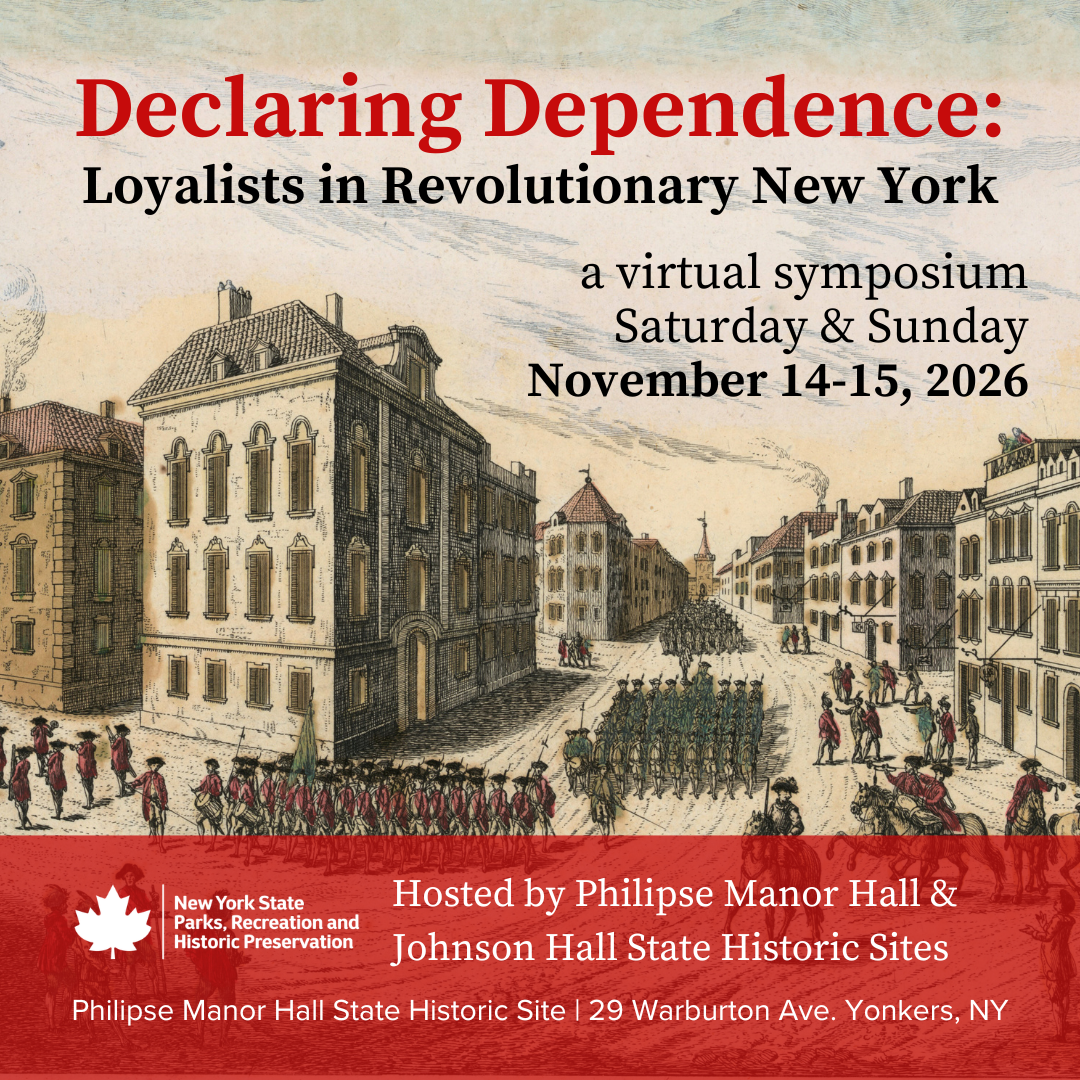
As we mark the 250th Anniversary of the American Revolution, Philipse Manor Hall State Historic Site and Johnson Hall State Historic Site are partnering to highlight the experiences of Loyalists in New York throughout the war. They will host a public virtual symposium, “Declaring Dependence: Loyalist in Revolutionary New York” on November 14-15, 2026 online.
9:30 AM – Virtual lounge opens
10:00 AM – Welcome & housekeeping
10:15 AM – Keynote – Ruma Chopra, “Choosing Sides,Choosing Empire: Allegiance in the 18th Century British Atlantic”
11:00 AM – Q&A
11:15 AM – Break (5 mins)
11:20 AM – Panel 1 - Occupied New York
Mark J. Noonan and Dominic Giardino explore everyday life in British-occupied Manhattan.
- 12:30 PM – Q&A
12:45 PM – Lunch Break (30 mins)
1:15 PM – Concurrent Session: Panels 2 & 3
Panel 2 – Mohawk Valley Perspectives
Mary C. Bartelt and Dr. Susan A. Brewer explore Loyalists in the Mohawk Valley and the role of the Johnson family and Haudenosaunee allies.
Panel 3 – Digital Interpretations
Dr. Leah Grandy and Heath Bowen (and team) explore how digital mapping and databases can make connections between Loyalists and their communities.
2:40 PM – Break (15 mins)
2:55 PM – Concurrent Session: Panels 4 & 5
Panel 4 – Divisions in Greater New York
John Knight and Vivian E. Davis explore practical realities and political divisions in Westchester County, NY and Bergen County, NJ.
Panel 5 – Proving Loyalties
Mark Sternberg and Mark Stolzenburg evaluate and explore professions and accusations of loyalty and their consequences.
4:20 PM – Break/Virtual Happy Hour
5:30 PM – Conference day 1 ends
11:30 AM – Virtual lounge opens
12:00 PM – Welcome & Housekeeping
12:15 PM – Keynote – Todd Braisted, “’To do the duty of Soldiers in Every Respect’: New York City’s Loyalist Militia, 1776-1783”
1:00 PM – Q&A
1:15 PM – Break (5 mins)
1:20 PM – Panel 6 – Loyalists in Exile
Dr. Richard Bell and John Fry examine how two Loyalists – William Franklin and Henry Simmons – faced displacement and exile for their political beliefs.
2:45 PM – Break (15 mins)
3:00 PM – Concurrent Session: Panels 7 & 8
Panel 7 – Black Loyalists in New York
Zachary Veith and Sarah Wassberg Johnson explore British promises of freedom and the experiences of Black Loyalists in New York.
Panel 8 – Recovering from a Civil War
Dr. Kieran O’Keefe and Daniel J. Hulsebosch explore the legal and social ramifications of dispossession for Loyalists post-war.
4:25 PM – Break/Virtual Happy Hour
5:30 PM – Conference ends
Full downloadable program coming soon!
Registration is now open! All registrants will be automatically added to both the Saturday & Sunday sessions. Registration is free and open to everyone, supported by the New York State Office of Parks, Recreation, and Historic Preservation. Register at the link below.
"Declaring Dependence" is hosted on WebEx, a secure video conferencing program. You can download WebEx here.
Dating back to the 1680s, Philipse Manor Hall sits near the confluence of the Nepperhan (Saw Mill) and Hudson Rivers, the site of a Munsee Lunaape village. Used by four generations of the Philipse family and worked by the people they enslaved and European tenant farmers, the Philipse Manor was once over 200,000 acres and helped make the Philipse family the richest in New York. The Philipses were Loyalists during the American Revolution and suffered political imprisonment, fought for the British, and ultimately were dispossessed of their 200,000 acre estate by New York State’s 1779 Act of Attainder. Forced to leave the colony on pain of death, in 1783 they fled to England. Their estate was auctioned off and Philipse Manor Hall later became Yonkers City Hall before being saved as a museum in 1908.
Johnson Hall was the 1763 Georgian-style estate of Anglo-Irish immigrant Sir William Johnson (1715 - 1774) and Molly Brant/ Konwatsi'tsiaienni of the Mohawks (1736-1796). They resided here with their eight children, numerous Native and European guests, and a large number of free, indentured, and enslaved servants. Their combined influence made them the most powerful family in the colonial Mohawk Valley, deeply impacting the diplomacy of the region and their wider worlds. Following the death of Sir William in 1774, Molly and her children left Johnson Hall, and his eldest son John inherited both the property and title of Baronet. By 1776, the new Revolutionary government forced this Loyalist family and many of their supporters to flee to Canada under threat of imprisonment and violence. Johnson Hall was seized and looted, with most of its remaining contents subsequently sold at auction following the war. In 1906 it was acquired by the State of New York and opened as a State Historic Site.
